

Three different CS leaders said something similar to me recently, in three totally different contexts.
“We need more technical CSMs.”
“We need commercial CSMs because renewals are slipping.”
“We need both but it’s so tough to find the talent in the market.”
Here’s the connecting pattern I want you to notice:
Teams keep trying to solve this as a role debate. The real issue is mismatch.
Your customers need different kinds of help at different moments, but your CS model forces one person to carry the whole load. That’s how you end up with burned out CSMs, confused customers and handoffs that feel messy.
The warning sign that proves this is your problem
You can usually spot role mismatch when job descriptions start reading like a superhero wishlist.
If your CSM role includes implementation, solution design, stakeholder management, renewal strategy, expansion identification, QBRs, plus “own adoption,” you’re already operating in role debt.
Because what you’re really doing is hiring a patch for an overloaded motion.
And this isn’t just hard on the team. It creates inconsistency for customers.
Some CSMs lean technical and the account gets solid setup but weak renewal leadership.
Some CSMs lean commercial and the account gets good stakeholder work but slower time-to-value.
Everyone is working hard, but the experience varies by who the customer gets.
Where the generalist CSM actually works (especially early stage)
Now, let’s add a third persona to the mix: the generalist CSM, which is worth mentioning because generalists are usually the default for a reason.
Generalist CSMs can be the perfect hire in early stage for one simple reason: the motion isn’t stable yet.
In early stage CS, you’re still figuring out:
- what “good onboarding” actually looks like across customers
- what outcomes matter most, and when
- where implementation tends to break
- what your strongest value narrative is
- what should be repeatable vs what genuinely needs bespoke support
Generalists are strong here because they can flex. They can learn fast. They can cover ambiguity without falling apart.
They’re also often the only thing that makes sense when:
- the customer base is smaller
- the product is still evolving
- your processes are still being invented in real time
- and you need people who can build while doing
So yes. Generalists can work.
But there’s a tradeoff.
Generalists stop being the answer when the organization starts demanding predictability.
Because once your customer volume grows, your implementation patterns repeat, and renewals become more formal, you’re no longer paying for flexibility. You’re paying for context switching.
And that’s where generalists start breaking down as a scaling strategy.
The moment generalists stop scaling
Generalists stop scaling when one of two things becomes true:
1) Product complexity becomes the bottleneck
Setup, integrations, configuration, or troubleshooting starts eating the calendar.
Technical work expands quietly because it feels urgent and visible.
2) Commercial complexity becomes the bottleneck
Decision rooms get bigger. Procurement shows up earlier. Renewals require stakeholder alignment and a value narrative that travels.
Commercial work becomes reactive because it feels less urgent until it’s suddenly urgent.
In both cases, the CSM role gets overloaded because one person can’t be the best option for every moment of the journey at scale.
Four plays to design the right CSM model
Here are four plays I use with CS leaders to decide what to hire for and what to redesign.
Play 1: Map “moments of truth” before you map roles
Start with the journey. List the 6 to 8 moments where customers either build momentum or lose it. For example:
- initial setup completed
- integration connected
- first workflow launched
- internal rollout started
- adoption dip addressed
- executive alignment achieved
- renewal prep started
- expansion path unlocked
Then assign the primary skill needed at each moment: technical depth, enablement, commercial negotiation, stakeholder exec alignment, change management.
A simple way to keep this honest: do the exercise with one real account and one week of actual CSM calendar data. You’ll see what your team is really spending time on.
Play 2: Use the 2×2 that makes role clarity obvious
Plot your customer base on two axes:
- Product complexity: low → high
- Commercial complexity: low → high (multi-stakeholder buying, procurement, renewal risk, expansion potential)
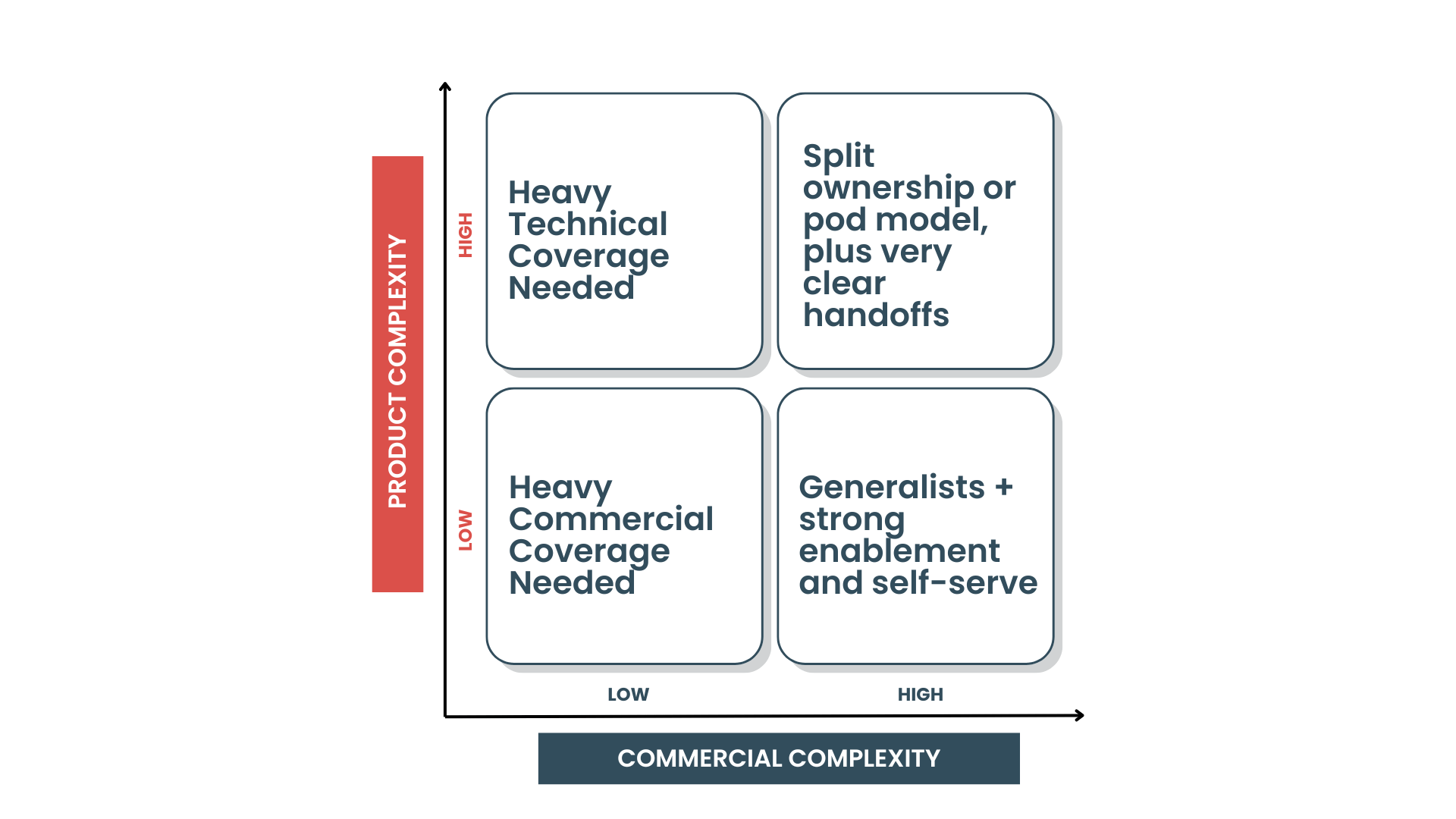
What tends to happen:
- High product complexity + low commercial complexity → heavy technical coverage need
- Low product complexity + high commercial complexity → heavy commercial coverage need
- High + high → split ownership or pod model, plus very clear handoffs
- Low + low → generalists + strong enablement and self-serve can work
One practical marker: if a meaningful chunk of your book sits in high product complexity, technical coverage cannot be “extra help when needed.” It needs an owner and a measurable queue.
Play 3: Decide what belongs in CS vs what belongs around CS
Technical coverage does not automatically mean “technical CSM.”
There are multiple models that work depending on your product and team:
- Technical Account Managers for implementation and integrations
- Solutions consultants as overlays for key moments
- An enablement function that builds repeatable learning paths
- Support plus a structured escalation path
- Professional services with clear boundaries and entitlements
A technical CSM can be the right answer. It can also be an expensive answer if the true need is repeatability.
If the same “technical question” or setup friction shows up repeatedly across accounts, it belongs in enablement, product UX, or a structured services motion, not in heroic CSM time.
Play 4: Write the “line of responsibility” in plain language
Most role confusion is a handoff problem pretending to be a hiring problem.
Define in one page:
- what CS owns end-to-end
- what gets handed to technical coverage and when
- what commercial conversations CS leads vs influences vs hands off
- what “done” looks like for each handoff
Include triggers that remove debate, like “integration not complete by Day 14” and attach the owner, response time, and next action.
Transition: Now that you have the plays, let’s anchor them with a few resources that sharpen your thinking.
The takeaway
If you’re at the point where you’re debating technical vs commercial CSMs, don’t force the answer in the job title.
Your next hire should be dictated by what’s currently slowing customers down.
- If customers can’t get set up and to first value without heavy CS involvement, you have a time-to-value bottleneck.
- If customers are using the product but renewals are getting harder to defend, you have a value and stakeholder problem.
- If both are true in the same segment, hiring another “strong CSM” is usually the most expensive way to avoid splitting ownership.
That’s it. The right role is the one that removes the bottleneck that keeps repeating.
If this question keeps coming up, here’s how I can help
This is one of the most common inflection points I work through with CS leaders: hiring strategy, role design, coverage models, and handoffs.
Inside my CS Strategy 1:1 Coaching, we take your customer base, product complexity, growth targets, and team capacity and design a system with:
- clear ownership by “moments of truth” in the journey
- repeatable plays for where customers get stuck
- handoffs that feel seamless to customers and sustainable for your team
You’ll get a kickoff strategy session, 3 months of coaching, async support, session recordings, plus customized templates and resources.
I say this all the time: the investment in coaching is lower than the cost of getting this wrong for another quarter. This pays for itself when it reduces CSM overload, prevents churn risk caused by messy handoffs, and helps you scale without hiring reactively.
📅 Book a free consultation call here to explore whether this is the right fit.